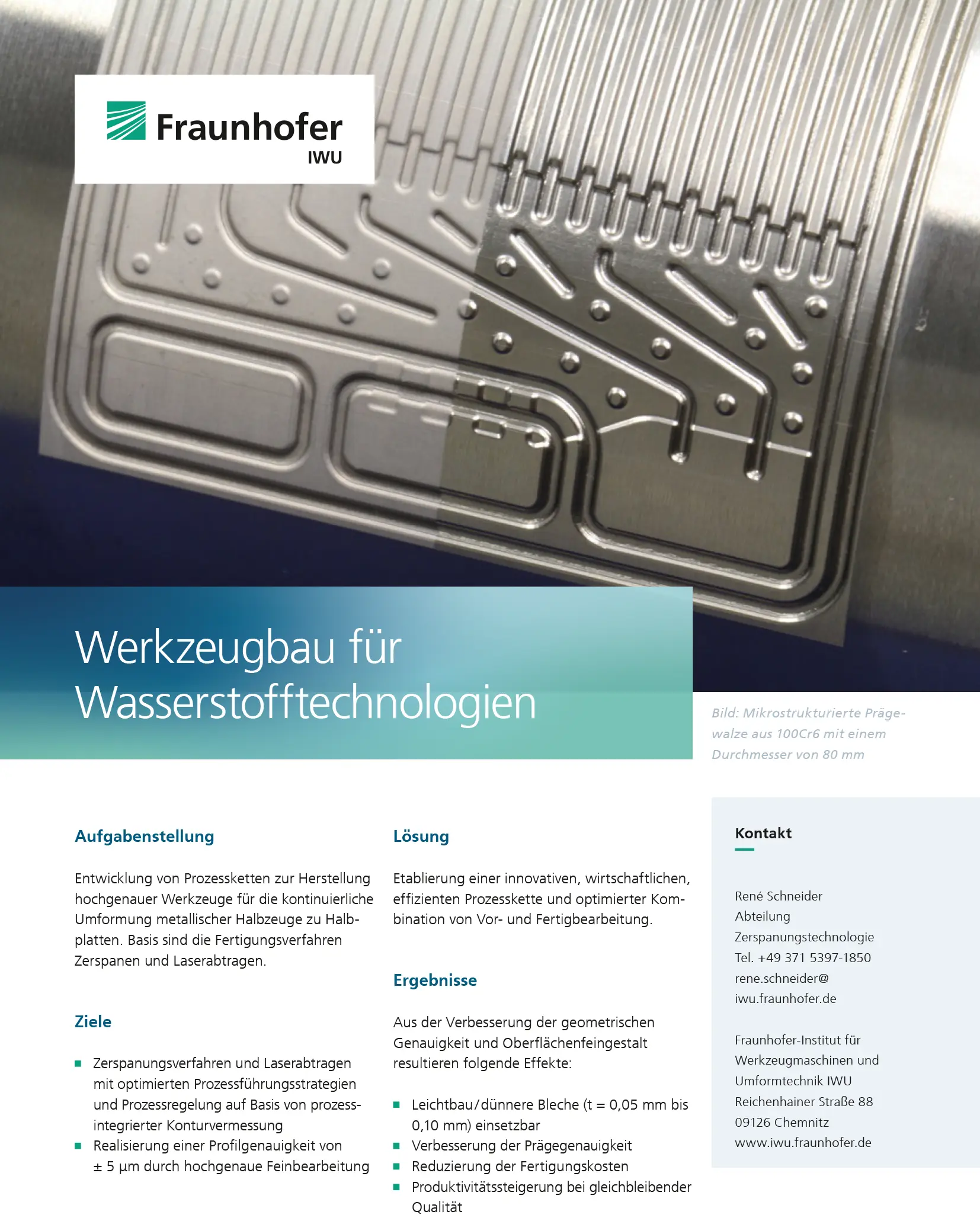
WEMA and Fraunhofer IWU cooperate for the future of the hydrogen economy
Between April 2023 and April 2026, Fraunhofer IWU and NSH Technology GmbH, WEMA Glauchau branch, are carrying out a research project on manufacturing technology for the production of profiled rollers for the production of bipolar plates in electrolysers for the hydrogen economy. The project was funded by the European Union and the Sächsische Aufbaubank.
The task: Production technology for profile rollers
High-precision profile rolling tools are required for their high-rate production by hollow roll embossing. The aim of the research project is the development and realization of production processes (machine, tools, systems) and machining technologies for the manufacture of these tools using innovative process combinations of machining (milling, grinding, polishing) and laser ablation.
In addition to productive and cost-effective tool production, the highest quality requirements in terms of shape and roughness must be ensured. This requires reproducible workpiece clamping. For this and for multi-stage and adaptive process control, process-related qualified measurement technology and technologies are required.
Other project objectives include the design of a combined machine for machining and laser ablation, the end-to-end digitalization of the manufacturing process and the component, and the consideration of the transferability of the technologies to other applications.
The challenge: hollow embossing tools
The implementation of ambitious energy and climate policies requires a comprehensive transformation of our energy systems and resource use. Hydrogen and its efficient production by electrolysers and use by fuel cells play a major role in this. The core component of both systems is the bipolar plate, the production of which is time-consuming and cost-intensive. There is significant potential for savings here through high-rate production processes, for which the development of production engineering and technologies and the establishment of corresponding production capacities are required.
The aim of the project is, on the one hand, the process development for the economic production of high-precision forming tools for bipolar plates by combining innovative machining and laser ablation processes in optimized process chains. On the other hand, the aim is the simultaneous consideration of the forming processes by validation tests and directly resulting requirements for tool production (e.g. quality characteristics for shape and roughness, material hardness).
The result is an overall process analysis for the production of forming tools based on the boundary conditions of tool production (e.g. process limits, productivity, costs) and simultaneous detailing and specification of the forming tools and processes through validation processes
This method enables the robust and productive manufacture of bipolar plates for energy technology systems. It can also be transferred to other applications in plant and medical technology.
Key data on the project
Runtime
April 2023 to April 2026
Coordination
NSH Technology GmbH, NL WEMA Glauchau
Funding body
Sächsische Aufbaubank
Co-financed by the European Union
Funding code
100670772
Other project partners
SITEC Chemnitz
GESAU Glauchau
DIT-Diamanttechnik Oberlungwitz